

Schools do not need clicks simply to increase website traffic. They need to reach parents who are actively looking for admission information and turn relevant searches into enquiries, calls and opportunities to speak with the school.
That is where PPC Services for Schools can play a practical role. A well-managed Google Ads campaign can help a school appear when parents are searching for admissions, schools in a specific area, or information related to particular classes and programmes.
School PPC is not simply about creating an advertisement and setting a budget. Location, search intent, admission timing, ad messaging, landing pages, search terms and conversion tracking all affect the quality of the enquiries generated.
I have hands-on experience working on PPC and Google Ads for Delhi Public School, NTPC Vidyut Nagar, Dadri. This experience has given me practical insight into the considerations involved in school advertising, particularly the need to connect paid search with relevant parent enquiries rather than treating clicks as the end goal.
Why Schools Need PPC for Admissions
Parents often begin their search for a school on Google. Their searches may start broadly and become more specific as they compare schools and look for admission information.
A parent may search for a school in a particular area, look for admissions for a particular class, or search for schools where admissions are currently open. Location can be especially important because distance, accessibility and the family’s local area often influence school selection.
This creates an opportunity for paid search. PPC for Schools can help institutions reach parents at the point when they are actively searching for information that may be relevant to their admissions.
However, visibility by itself is not enough.
A campaign can generate a large number of clicks without producing useful admission enquiries if the targeting is too broad or the advertising does not match the searcher’s intent. The focus should therefore be on attracting relevant visitors and making it easy for genuinely interested parents to take the next step.
Google Ads for School Admissions
Google Ads for School Admissions can help schools reach parents at different stages of the decision-making process.
Depending on the school’s admissions, location and audience, searches may relate to:
- School admissions
- Admissions open
- Nursery admission
- Class-specific admissions
- CBSE schools
- Schools near a particular location
- School admission near me
These searches do not all represent the same intent. Someone researching schools generally may still be exploring their options, while a parent specifically looking for admission information may be closer to contacting a school.
A Google Ads Campaign for Schools should account for these differences. Search intent can influence campaign structure, ad messaging, landing-page recommendations and the actions that should be tracked.
The aim is not to assume that every admission-related search will produce a lead. Instead, the campaign should identify relevant searches, provide a clear and accurate message, and give interested parents a straightforward path to contact the school.
PPC Strategy for Schools
Effective PPC Management for Schools involves several connected areas of campaign planning and ongoing management.
Keyword and Search Intent Research
The starting point is understanding how prospective parents may search for schools and admissions.
Different searches can indicate different levels of intent. A general school-related search may not indicate immediate admission interest, while a more specific admission search can signal a stronger need for information.
The campaign should reflect these differences instead of treating every search as equally valuable.
Location Targeting
School advertising is highly location-sensitive. Most schools serve particular communities and surrounding areas, so advertising should be aligned with the locations that matter to the institution.
Relevant geographic targeting can help reduce exposure to unsuitable traffic and make advertisements more useful to families who can realistically consider the school.
Campaign Structure
Campaigns should be structured so that different admission themes, locations or objectives can be monitored and managed effectively.
A clear structure makes it easier to understand which areas are generating useful engagement and where changes may be required. It also provides a better foundation for ongoing campaign optimisation.
Ad Copy
School advertisements need to communicate relevant information clearly.
The messaging should reflect the searcher’s intent and encourage the right audience to learn more. Admission-focused advertising should accurately represent the information available from the school rather than relying on exaggerated claims or generic promotional language.
Negative Keywords
Not every school-related search is relevant to an admission campaign.
Negative keywords can help reduce unwanted exposure to searches that do not align with the school’s objectives. Reviewing actual search terms is particularly useful because it shows how people are really searching and can reveal opportunities for both targeting and exclusions.
Landing Pages
Sending every visitor to a generic homepage is not always the most effective approach.
Someone clicking an admission advertisement should be able to quickly find the information they expected from the ad. A relevant page with clear admission information and straightforward calls to action can create a more consistent journey from search to enquiry.
Conversion Tracking
Calls, enquiry forms and other meaningful actions can provide a much clearer picture of campaign performance than traffic figures alone.
Conversion tracking helps identify which campaigns, ads or targeting approaches are contributing to measurable actions and gives the data needed for informed campaign decisions.
Search-Term Analysis and Optimisation
PPC campaigns need regular attention after they go live.
Search terms, ad performance, conversions, targeting and other available campaign data should be reviewed regularly. This allows campaigns to be refined based on actual user behaviour rather than assumptions made during initial setup.
Local PPC for Schools
Location is one of the strongest considerations in school advertising.
Parents frequently combine school-related searches with geographical intent. They may look for a school in a particular locality, admission information connected with an area, or schools near where they live.
For example, a parent might search for a school near Dadri, school admissions in a particular locality, or schools near their home.
Local PPC for Schools can help focus advertising around geographic areas that are relevant to the institution rather than relying on broad targeting.
The purpose is not simply to advertise to everyone within a large area. Location settings, search terms and campaign performance should work together to reach a more appropriate audience and limit traffic that is unlikely to result in a useful school enquiry.
School Admission Lead Generation Through PPC
The admission journey can be viewed as a straightforward sequence:
Search → Google Ad → Landing Page → Enquiry/Call → Follow-up
Every stage has a role.
A relevant search needs an appropriate advertisement. The advertisement needs to lead to a page that matches what the parent is looking for. That page should make it easy to enquire or call. The resulting enquiry then needs an appropriate follow-up process.
This is why School Admission Lead Generation should not be measured by clicks alone.
A campaign can generate traffic without generating meaningful enquiries. A more focused campaign may attract fewer visitors while producing enquiries that are more relevant to the school’s admission objectives.
The purpose of PPC is therefore to create a useful connection between search demand and the school’s admission process.
My Experience With PPC for Schools
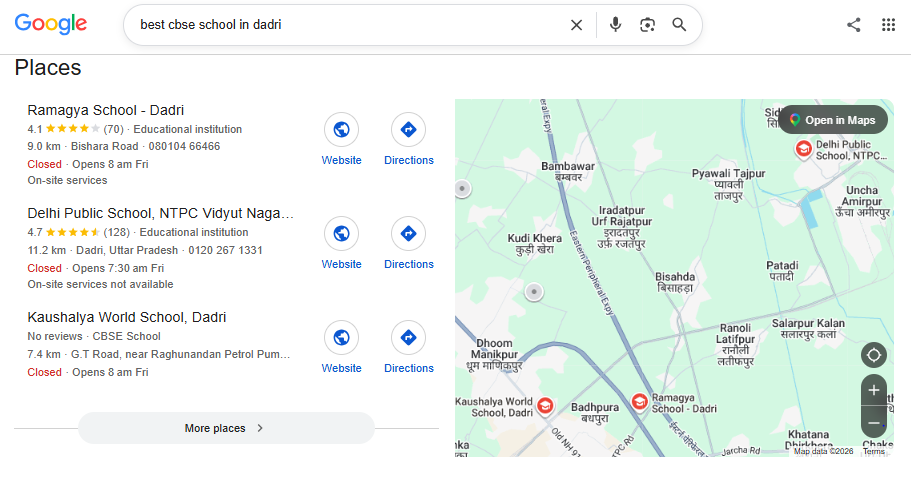
I have hands-on experience working on PPC and Google Ads for a school, including Delhi Public School, NTPC Vidyut Nagar, Dadri.
Working on a real school campaign provided practical exposure to the differences between school PPC and generic lead-generation advertising. Parents are a distinct audience, school selection involves a significant decision, and local relevance can have a major influence on whether an enquiry is useful to the institution.
This experience has helped me understand the importance of matching advertising with parent search intent, considering the school’s relevant geographic audience, and creating a clear path from an advertisement to an enquiry.
It has also reinforced an important distinction: a click is not automatically a successful result. The quality of the visitor and the action they take after reaching the website matter.
I do not present unsupported campaign figures or assumptions as results. Where campaign data is available, it can be used to make informed decisions. Where it is not, the focus remains on sound PPC practices, accurate tracking and continuous improvement.
Google Ads Experience With DPS Vidyut Nagar
My work with DPS Vidyut Nagar is a genuine example of my hands-on experience with PPC for schools.
Rather than presenting it as a case study with figures that are not available, I use the experience for what it genuinely demonstrates: practical familiarity with the challenges of school-focused paid advertising.
Working in this environment requires thinking about the parent’s search journey, the relevance of the advertisement, the information available after the click and how enquiries can be tracked.
Those considerations inform my approach to other school campaigns as well. Every school has different locations, admission requirements, audiences and objectives, so the strategy should be adapted to the individual institution rather than copied from another campaign.
What Makes School PPC Different?
School PPC has several characteristics that make it different from a typical lead-generation campaign.
Parents are the audience. Advertising needs to provide clear and relevant information while building enough confidence for parents to explore the school further.
Location matters. A school generally has a practical geographic audience. Enquiries from unsuitable locations may have limited value.
Admission seasons influence demand. Search behaviour and competition can change during different periods of the admission cycle, so campaign activity needs to reflect the school’s current requirements.
Class-specific requirements matter. Parents may be looking for admission information for a particular age group, class or stage of education.
Trust matters. Choosing a school is not an impulse purchase. The advertising and landing-page experience should help parents find the information they need before making contact.
Lead quality matters. A form submission is not automatically a qualified admission opportunity. Schools need to consider whether enquiries are relevant and whether they can be effectively followed up.
Common PPC Mistakes Schools Should Avoid
Several common issues can reduce the effectiveness of school advertising:
- Using overly broad targeting
- Poor geographic targeting
- Ignoring negative keywords
- Sending every visitor to a generic webpage
- Using weak or unclear ad messaging
- Failing to track calls and forms
- Measuring only clicks and impressions
- Not reviewing actual search terms
- Leaving campaigns unchanged for long periods
These issues can often be addressed through proper campaign setup, regular monitoring and ongoing optimisation.
How Schools Can Measure PPC Performance
Schools should look beyond impressions and clicks when evaluating Google Ads.
Useful performance indicators can include:
- Admission enquiries
- Phone calls
- Form submissions
- Qualified leads
- Cost per lead
- Conversion rate
- Search-term performance
The right measurement approach depends on how the school receives and manages enquiries and which actions are considered valuable.
For example, a form submission is a measurable conversion, but understanding whether that enquiry is relevant to the school’s admission requirements provides a more useful view of campaign quality.
Good Google Ads Management for Schools should therefore connect advertising activity with meaningful actions wherever those actions can be tracked reliably.
How Much Does PPC for Schools Cost?
There is no fixed PPC cost that applies to every school.
Advertising costs can vary depending on:
- Location
- Competition
- Search terms
- Admission season
- Advertising budget
- Campaign scope
- Target audience
- Number of campaigns
- Landing-page requirements
There are also two separate costs to consider: the advertising spend paid to the advertising platform and the PPC management fee for planning, managing, monitoring and optimising the campaigns.
A suitable budget should be considered in relation to the school’s target area, admission objectives, competition and campaign requirements rather than choosing a standard amount without considering the circumstances.
Why Choose A1 Digital Marketing for School PPC?
A1 Digital Marketing approaches school PPC with a practical focus on campaign management, relevant targeting and measurable actions.
Based on hands-on experience with PPC for a school, I understand that school advertising requires more than simply driving traffic to a website. Campaigns need to consider parent search intent, local targeting, admission-focused messaging, negative keywords, landing-page relevance and conversion tracking.
PPC support for schools can include:
- PPC campaign setup
- Search and intent research
- Google Ads management
- Location targeting
- Negative keyword management
- Ad copy development
- Conversion tracking
- Search-term analysis
- Performance monitoring
- Ongoing campaign optimisation
- Landing-page recommendations
The objective is to build and manage campaigns around the school’s actual requirements and available performance data, rather than focusing on clicks for their own sake.
If your school is considering Google Ads for admissions, A1 Digital Marketing can discuss your PPC requirements and help determine an appropriate approach for your target locations, audience and admission goals.
FAQs About PPC Services for Schools
What are PPC Services for Schools?
PPC Services for Schools involve planning, setting up, managing and optimising paid advertising campaigns to reach relevant parents searching for schools, admissions and related information. Google Ads can be used as part of this approach.
Can Google Ads help with school admissions?
Yes. Google Ads for Schools can help reach parents who are actively searching for admission-related information. The quality and volume of enquiries will depend on factors such as targeting, competition, search demand, budget, messaging and the landing-page experience.
How much does PPC for schools cost?
There is no universal price. PPC costs depend on factors such as location, competition, search demand, admission season, campaign scope and advertising budget. Advertising spend and PPC management fees are separate costs.
How does PPC generate school admission leads?
A typical journey is search → advertisement → landing page → enquiry or call → follow-up. The campaign should be designed to attract relevant searches and make it straightforward for interested parents to contact the school.
How long should a Google Ads campaign for a school run?
There is no single ideal campaign duration. It depends on the school’s objectives, admission calendar, budget and available performance data. Campaigns should be monitored and adjusted throughout their active period rather than left unchanged.
How should a school measure Google Ads performance?
Schools can monitor enquiries, calls, form submissions, qualified leads, cost per lead, conversion rate and search-term performance. Clicks and impressions are useful supporting metrics, but they should not be the only measures used to assess a campaign.
Is local PPC useful for schools?
Yes. School selection is often closely connected to location. Local PPC for Schools can help focus advertising on geographic areas relevant to the institution and reduce exposure to searches from locations that are unlikely to produce useful admission enquiries.
Discuss Your School’s PPC Requirements
If your school is looking to use Google Ads for admissions or improve an existing PPC campaign, the first step is understanding your target audience, locations, admission objectives and current advertising setup.
Speak with A1 Digital Marketing about your school’s PPC requirements and explore a practical approach to Google Ads and school admission lead generation.
